
DocIntel v2 — Document Intelligence Platform
RAG pipeline with stage telemetry and retrieval evaluation

Media & Demos
Dashboard — Pipeline Health & Metrics
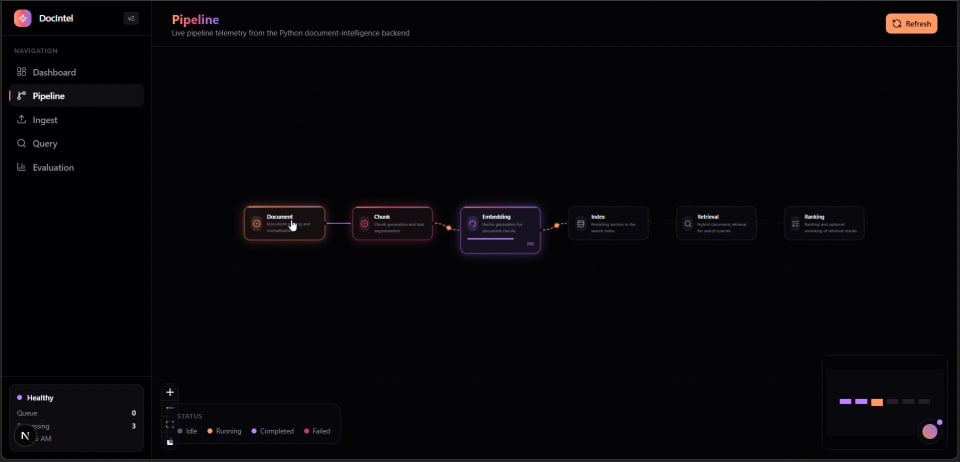
Pipeline — Live Stage Telemetry

Ingest — Document Upload & Queue

Evaluation — Precision@K & Query Breakdown
DocIntel Platform Demo
Role
Full-Stack Engineer
Period
2026
Category
ai
Overview
A document-RAG application covering ingestion, parsing, chunking, embeddings, indexing, retrieval and ranking, with stage-level telemetry and a Precision@K evaluation suite so retrieval quality can be measured. Counts below are from my own runs.
Key Highlights
- 6-stage processing pipeline: Document → Chunk → Embedding → Index → Retrieval → Ranking
- Live pipeline telemetry with stage-level status, throughput, and latency visibility
- 141,857 indexed vectors across 1,048 source documents (self-reported, private repository)
- Hybrid retrieval path with optional reranking for higher answer relevance
- Ground-truth evaluation suite with Precision@K and per-topic breakdown
- Operational dashboard for queue depth, ingestion health, and index status
Tech Stack
Links
Summary
On-page overviewThis is a concise summary of the challenges, solution, and outcome for this project. Use the Case Study button above for the full deep dive.
The Problem
Most RAG implementations provide answers but little observability. Without stage-level telemetry and evaluation baselines, teams cannot diagnose retrieval failures or quantify quality regressions.
The Solution
Built an end-to-end RAG operations layer where each pipeline stage is measurable, query behavior is inspectable, and retrieval quality is benchmarked through a reproducible Precision@K suite.
The Outcome
A working RAG application that processed 1,048 documents into 141,857 vectors (self-reported) with health instrumentation and a repeatable retrieval evaluation.
Team & Role
Built the application, retrieval and evaluation design.
What I Learned
RAG quality improvements came from observability discipline, not model swaps. Instrumenting chunk quality, retrieval depth, and topic-level precision made it possible to iterate using evidence instead of intuition.